Loading works…


Coffee Idle Simulator
An idle cafe simulation that sits in a strip along the bottom of your monitor. While you work, rain falls, coffee brews and customers leave their stories. The web prototype was scrapped and it is being rebuilt in Godot.
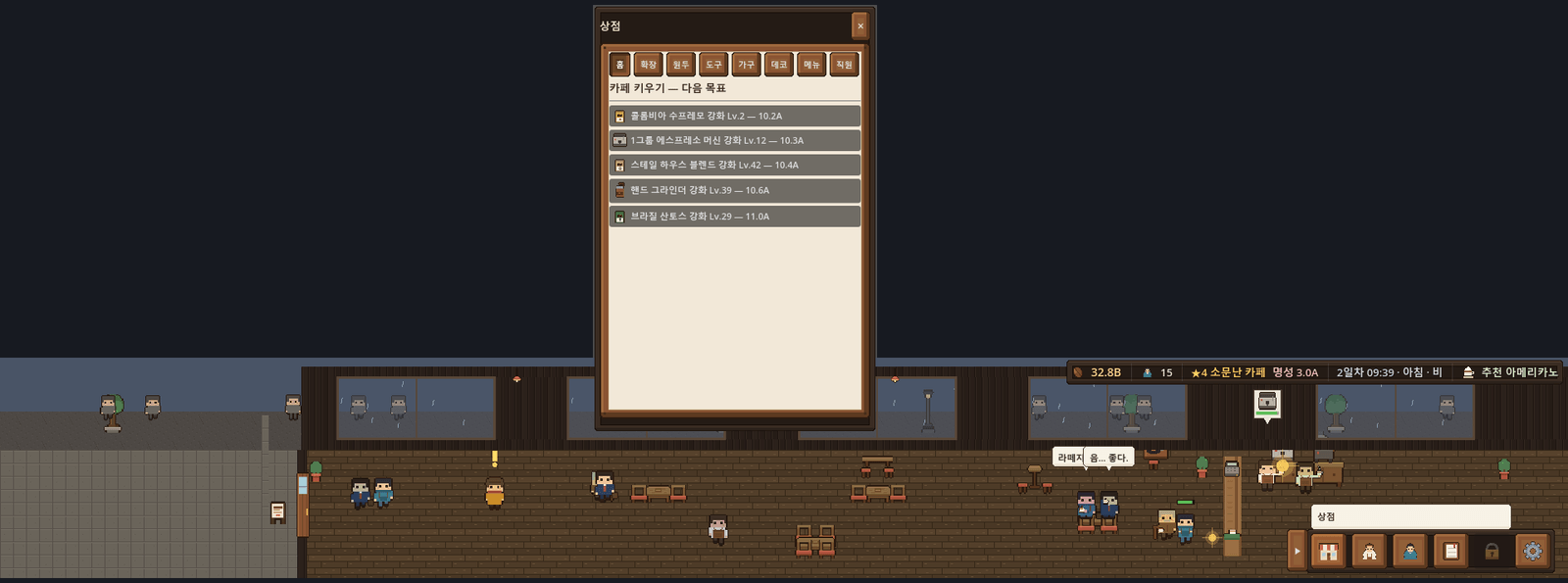
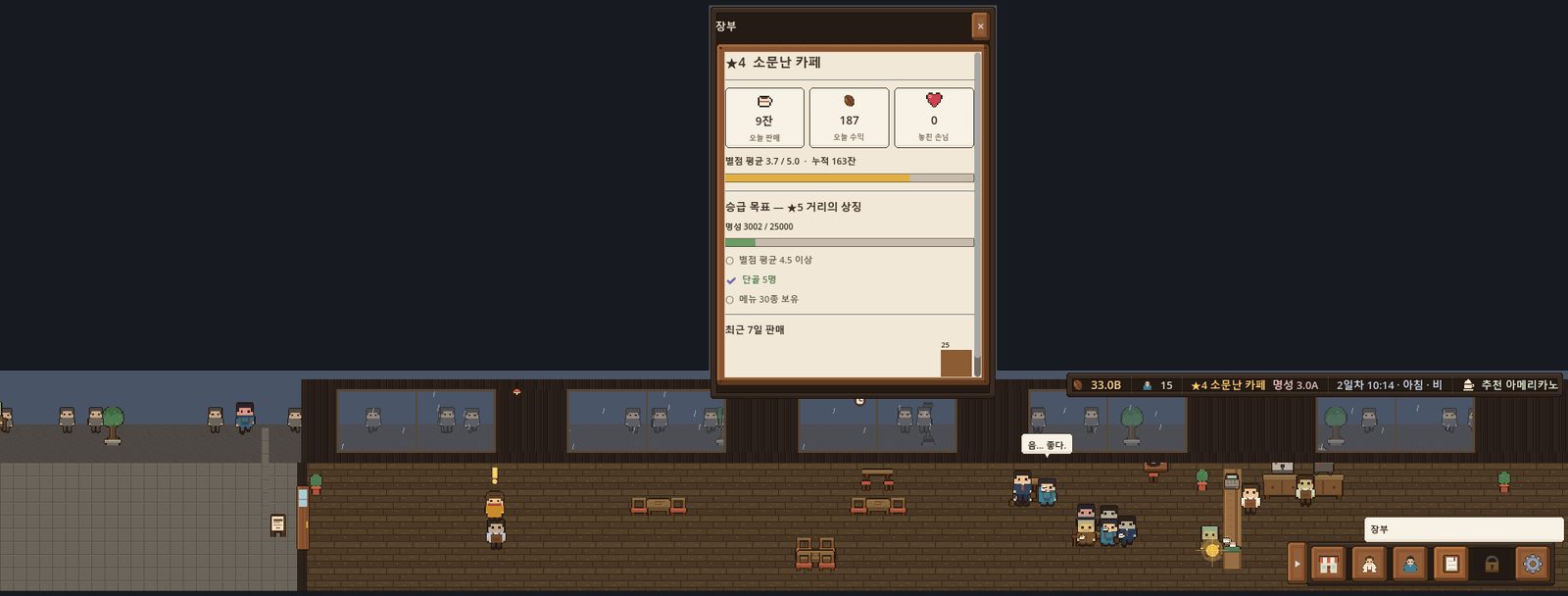
Screenshots
Overview
"While you work, in a strip of cafe below your monitor, rain falls, coffee brews and people's stories pile up."
An idle cafe simulation that does not take the full screen. It sits as a horizontal strip along the bottom of the desktop, designed to be watched out of the corner of your eye while you do something else. Target platform is PC via Steam.
What is built
The cafe loop runs. Customers order by preference, a daily recommendation comes up, the ledger fills, and cafe rank and promotion quests sit on top.
On the customer side, anthology story NPCs visit, talk and reward you. Enough affinity promotes one into a regular, and regulars get guaranteed visits, attachment tiers and an entry in the codex.
You grow the shop with beans, furniture, decor and tools. Staff are hired into roles and positions, and hall-expansion furniture and street props widen the space.
A day has its own texture. Rain brings a footfall bonus, seasons turn, and a daily liveliness multiplier and golden sparkles come and go. Above all that sits a prestige loop that unlocks a permanent bonus tree and reopens the shop.
Why it was rebuilt
It began as a React + Tauri web prototype. That was scrapped in 2026-07 and moved to Godot 4.6. The bottom-strip overlay form fought constantly with window control, fullscreen promotion and the taskbar. Sustaining an idle game's continuous rendering inside a webview was expensive too.
The move came with a data standardisation. Beans, furniture, guests, recipes, staff and story definitions were split into 13 static JSON files, display strings into 7 translation files, and tuning values gathered into a single design-config.json and pulled out of the code.
Verification
A data integrity checker (verify_integrity.py) runs alongside a pacing simulator (balance_sim.py), catching what the eye cannot: integer typing, monotonicity across tiers. The design document is kept across 19 chapters.